The Pioneer: Learn the Story Behind Former USWNT Captain and Head Coach April Heinrichs
Heinrichs led U.S. Women’s National Team to first World Cup title before becoming the program’s first female head coach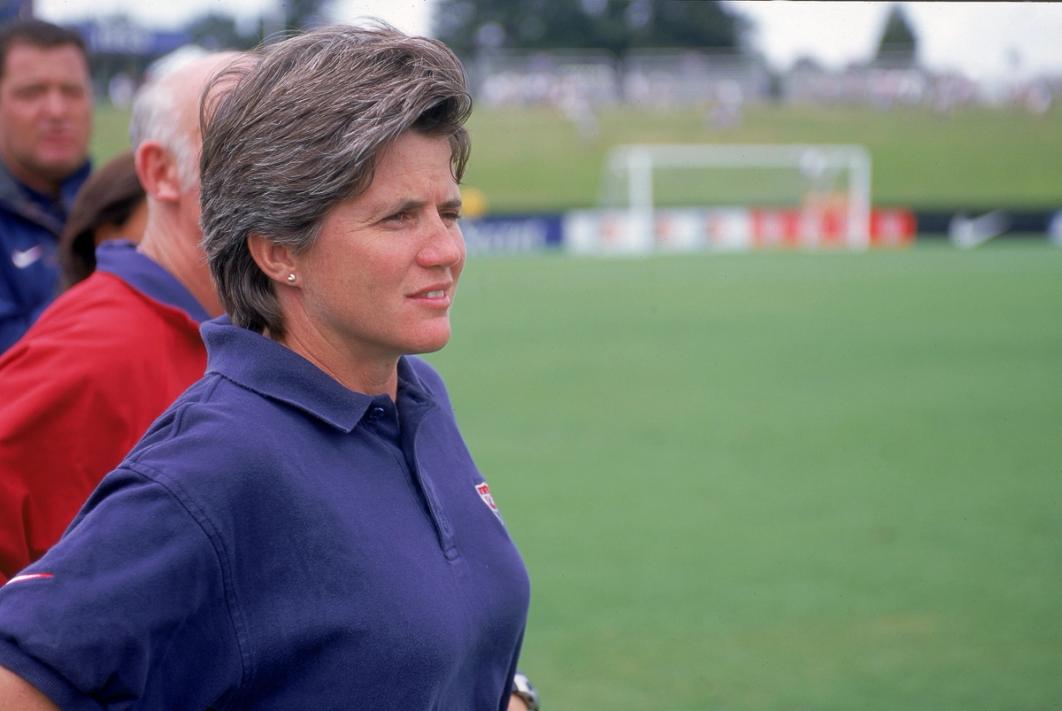
Every Thursday in March, U.S. Soccer will share a story about various unsung heroes and lesser-known moments in U.S. Women's National Team history for Women's History Month.
Eighty-six players have competed for the U.S. Women's National Team in a FIFA Women's World Cup match. Seven different coaches have led the team through the nine editions of the tournament. Only one has done both.
In 1991, April Heinrichs captained the USWNT to its first World Cup title and 12 years later guided the squad to third place in the 2003 FIFA Women’s World Cup. As a coach for several levels of the USA’s Youth National Teams before she took the helm of the USWNT, a long-time college head coach, and then later becoming the first technical director for the U.S. Women’s Youth National Teams, Heinrichs left her mark on nearly every aspect of the women's game in the U.S.
The forward was a part of the beginning of more than one soccer powerhouse. She played for the University of North Carolina from 1983-1986 and won three of the Tar Heels’ first four NCAA championships to start a dynasty. Fresh out of college, Heinrichs made her USWNT debut on July 7, 1986, in what was the team's fourth-ever match and its first win. She played in matches for the USA every year leading up to the inaugural FIFA Women’s World Cup.
“Going to China in 1991, we had very little expectations other than we wanted to win,” Heinrichs told FIFA. “We felt that we were competitive enough. We felt that we could compete with any team in the world. We had a great, competitive spirit, and we just took one game at a time.”
The USA narrowly defeated Sweden 3-2 to open the tournament but rebounded with dominant 5-0 and 3-0 wins over Brazil and Japan to advance to the knockout stage. The team kept the momentum rolling and routed Chinese Taipei, 7-0, in the quarterfinal before taking down Germany, 5-2, in the semifinal.
Heinrichs scored four goals in the tournament, including the last two against Germany. Before the USWNT attacking trio “Triple Espresso,” there was the “Triple-Edged Sword” that featured three dynamic dribblers and goal scorers in Heinrichs, Michelle Akers and Carin Jennings. The three forwards combined for 18 goals in the first five matches at the 1991 World Cup to lead the team to the Final against Norway.
“I remember the volume of people in the stands,” Heinrichs recalled. “It was packed. It really felt like a World Cup Final.”
Akers excited the crowd of 63,000 in the first half when she headed in the opening goal, but Norway equalized soon after. The game-winner came in the 78th minute of an 80-minute match – FIFA had made the women’s matches 80 matches before changing to the standard 90-minutes for the 1995 Women’s World Cup – after Akers’ high pressure led to a giveaway in Norway’s defensive third. She intercepted the pass, took a touch around the goalkeeper and rolled the ball into an empty net for her tenth goal of the tournament. The USA held on for the 2-1 win and the first of its four World Cup titles.
“The music plays and the (FIFA) President gives the trophy over,” Heinrichs said. “For me, that stands out as the greatest sporting moment of my life.”
It was also the final moment of Heinrichs’ playing career, as she was forced to retire from playing after the tournament due to knee injuries. She finished her international career with 35 goals in 46 appearances.
She didn’t stay away from the game for long. Heinrichs turned to college coaching and saw success at Princeton University, the University of Maryland and the University of Virginia. She was named Atlantic Coast Conference Coach of the Year in 1995 after leading the Terps to their first NCAA Tournament berth, and she took the Cavaliers to four consecutive NCAA Tournaments, including a trip to the Round of 16 in 1999.During this time, she also was an assistant coach for the USA’s 1995 FIFA Women’s World Cup Team, a scout for the USA during the 1999 FIFA Women’s World Cup and was coaching the U.S. Under-16 Girls’ National Team.
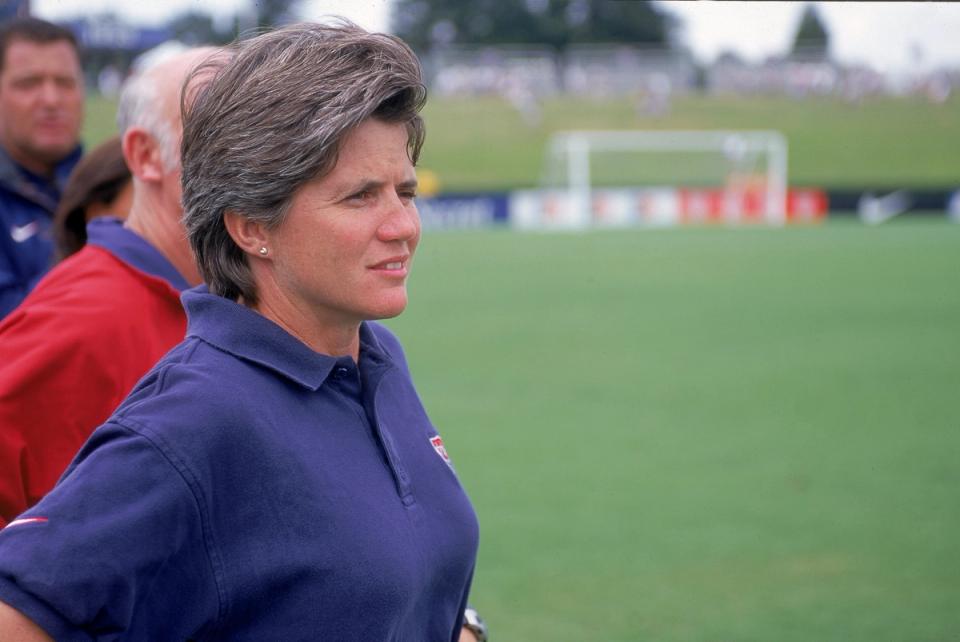
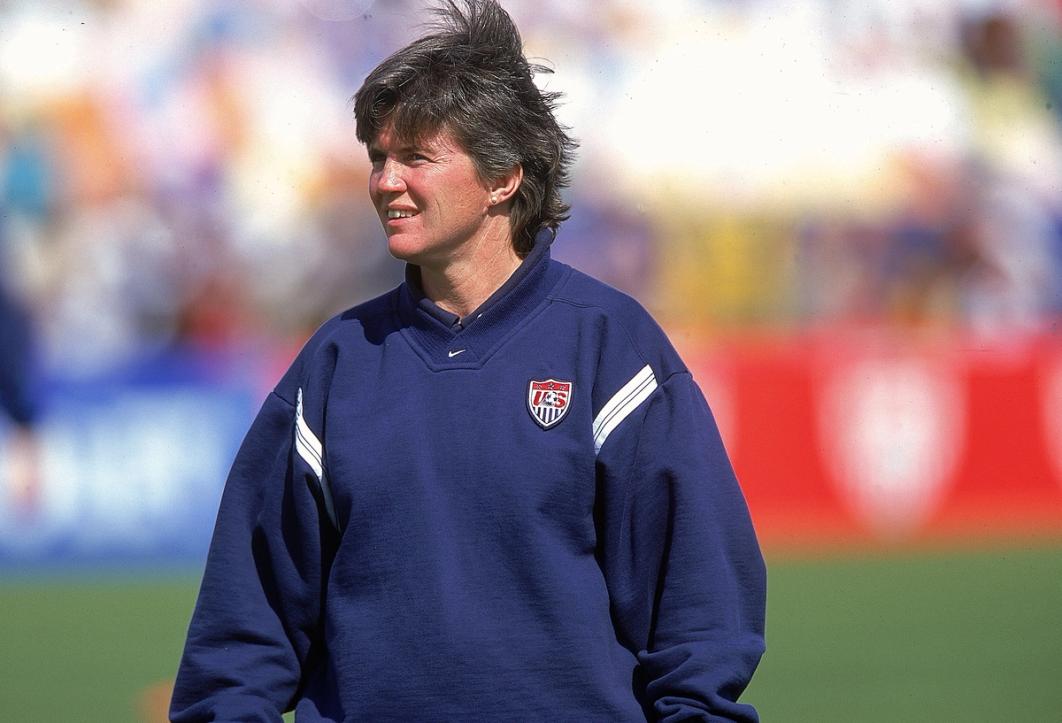
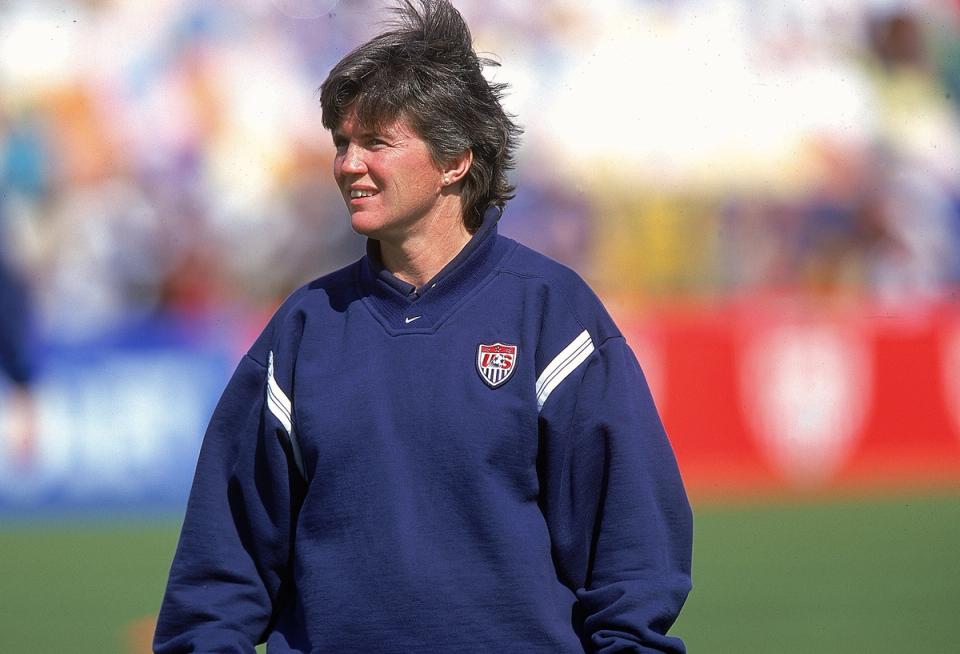
It was a natural progression for Heinrichs to become the senior team head coach when she was appointed in 2000, after legendary head coach Tony DiCicco stepped down. Heinrichs was the fourth head coach in program history and the first female head coach. In her five years with the team, she compiled a record of 87W-17L-20D.
In just a few months at the helm, Heinrichs led the team to a silver medal at the 2000 Olympic Games in Sydney, Australia, losing in a final match in which the USA outplayed Norway, but fell on a golden goal in overtime. A few years later, the USWNT defeated Canada in the Third-Place Match to take bronze in the 2003 FIFA Women’s World Cup. Heinrichs’ squad finally stood at the top of the podium in the 2004 Athens Olympics following the USA’s 2-1 win over Brazil after extra time in the gold medal game.
Once again bowing out on a high note, Heinrichs left U.S. Soccer and returned briefly to the college game before spending four years as Sport Performance Director with the United States Olympic Committee. In 2011, she came back to the Federation as the Technical Director for the Women’s Youth National Teams. In that position, she spent eight years implementing a program that has continued to blossom since. When she stepped down in 2018, U.S. Soccer had a National Team for every birth year from U-14 through U-20 and a full-time head coach for each team.
Heinrichs became the first female player inducted into the National Soccer Hall of Fame in 1998 and was inducted into the United Soccer Coaches Hall of Fame in 2024.
As the U.S. Women’s National Team continues to lead and excel on the world stage today with a plethora of leaders including captain Lindsey Heaps, head coach Emma Hayes and sporting director Matt Crocker, much of that foundation was set by the work of April Heinrichs.